The Labyrinth of Saudade
Permanent Collection, Rotterdam
A New Archetype for the Portuguese House.
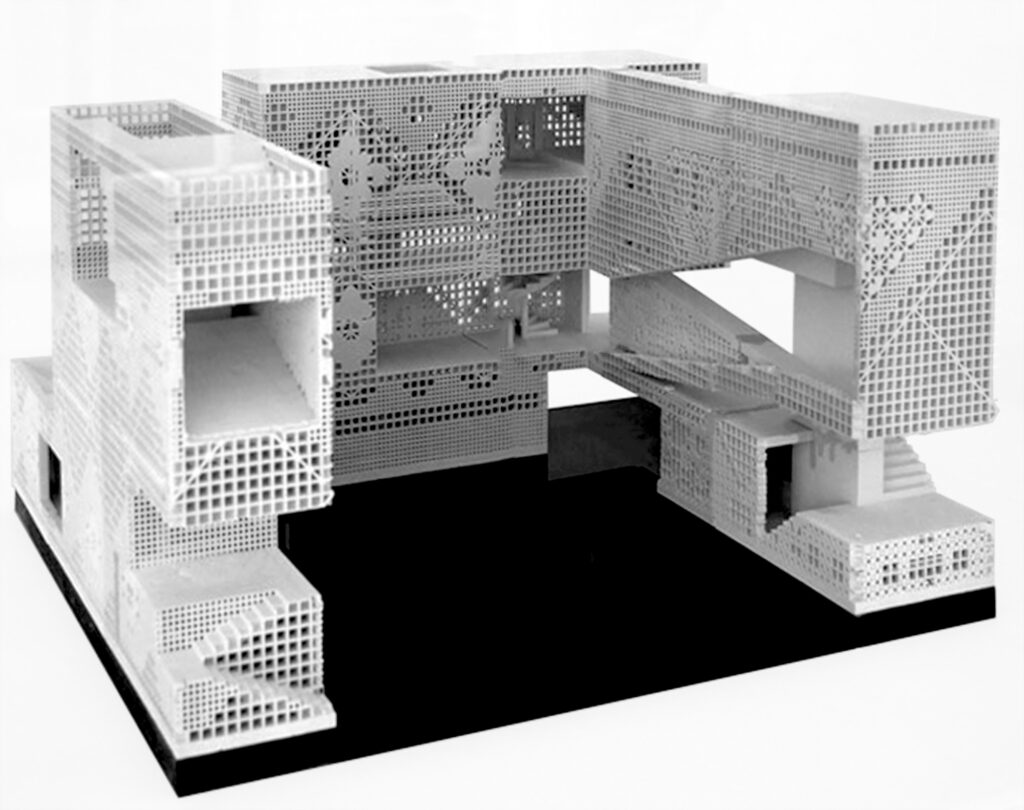
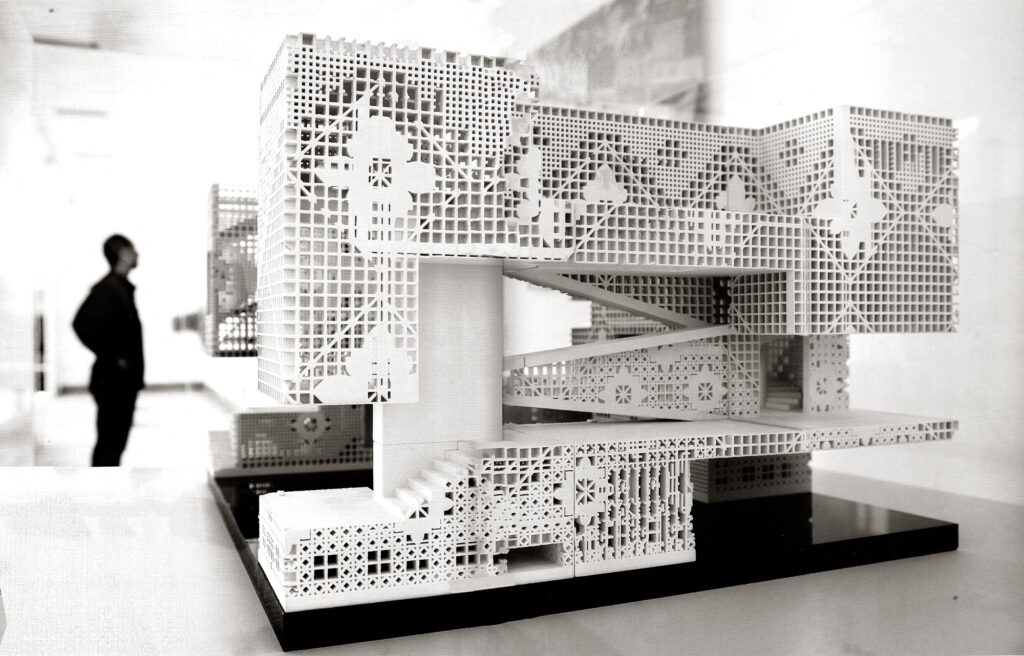
Developed as part of a research programme on housing models, Labirinto da Saudade is an analytical and sociological inquiry into the Portuguese House and its ways of inhabiting. From this investigation emerges an archetype: a single, solid volume containing all the spaces of domestic life, capable of adapting to the specific limits of each site while preserving its essential dimensions.
A structural grid covers the building, reproducing the geometry of a traditional Portuguese embroidered tablecloth. Here, embroidery becomes a marker of social status: Renda de Bilros (bobbin lace) for the upper class, Ponto-Cruz (cross-stitch) for the upper-middle class, and Crochet for the middle class. The remaining classes are, quite simply, excluded from home ownership.
The house is organised between two opposing conditions: the Spaces of Display, exposed to the exterior, and the Intimate Spaces, concealed behind the embroidered structure. Between them, ambiguous spaces mediate between public appearance and private life.
Each space may have one or several entrances, depending on the family occupying the house and the relationships between its members — love, indifference, passion, sadness, curiosity, contempt, excitement, hatred, or envy. Behind its apparently simple geometry lies a catalogue of social hierarchies, domestic rituals and exclusions.
The archetype of the Portuguese House thus becomes a critical and ironic device: a seemingly neutral structure that reveals the social codes embedded in the act of inhabiting.
The project is now part of the permanent collection of the Museum Boijmans Van Beuningen in Rotterdam.